
If you're reading this, you're probably thinking about expanding into a new market. Maybe you've got traction in the UK and you're wondering whether France, Germany, Spain or Italy could be the next chapter. Maybe you've had overseas interest and you're not sure your current website does justice to that opportunity.
The instinct most brands have at this point is to translate the website. Reasonable enough. But translation is only part of the picture, and for a lot of businesses, it's the part they get most wrong.
This guide covers what multilingual website development actually involves, why AI translation isn't the shortcut it appears to be, what good localisation looks like in practice, and how to figure out which approach makes sense for where you are right now.
What is multilingual website development?
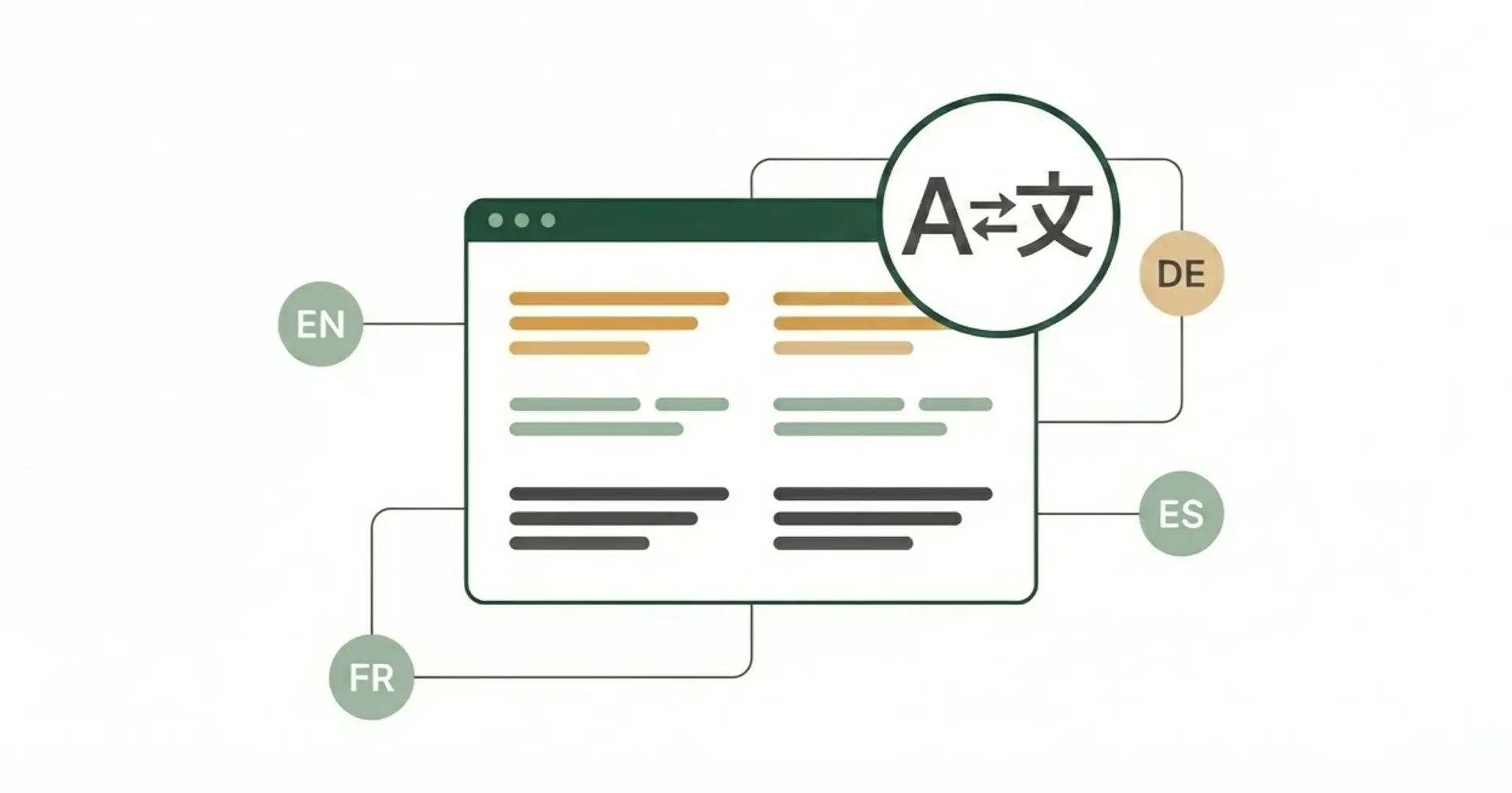
Multilingual website development is the process of building, adapting, and optimising a website so it can serve audiences in more than one language, and do so properly.
That distinction matters. A multilingual website isn't just a translated one. It's a site that's been thoughtfully rebuilt for a different market:
- the copy reads naturally in the target language
- the search terms are relevant to how people actually search in that country
- the cultural framing lands correctly
- the technical implementation means search engines know which version to show to which users
Translation is one component. But it sits alongside SEO, copywriting, user experience, and technical build decisions that all have to work together. Pull any one of them out of alignment and the whole thing underperforms.
Why enter a new market in the first place?
Before getting into the how, it's worth grounding the why.
The commercial case for multilingual websites is well documented. CSA Research surveyed over 8,700 consumers across 29 countries and found that 76% of online shoppers prefer to buy products with information in their native language, and 40% say they will never buy from a website in another language at all.
The ROI data backs this up. A DeepL survey found that 96% of B2B leaders reported a positive return from localisation efforts, with 65% seeing at least a 3x return.
And for context on the opportunity: English reaches only approximately 19% of the world, yet nearly half of all websites are written in it. If your website only speaks one language, you're cutting yourself off from most of the internet's potential audience before anyone has even found you.
Translation vs localisation: what's the difference?
These two terms get used interchangeably, but they're not the same thing, and the difference matters.
Translation is converting words from one language to another. It's what Google Translate does. It's what most people think of when they imagine making a website multilingual.
Localisation goes further. It's the process of adapting your entire message, your copy, your cultural references, your tone, your SEO strategy, even your imagery choices, so that your website genuinely feels like it was made for that market, not just converted for it.
A translated website says the right words. A localised website makes the right impression.
The difference might seem subtle until you see it in practice. A direct translation of a product description might be grammatically correct and still come across as stiff, flat, or slightly off, because it's carrying the rhythm, idioms, and assumptions of English into a language where those things don't land the same way.
Think about when you read some copy or advertising and it makes you chuckle. Or when you read something that really invokes emotion because it’s worded in a way that strikes a chord. That’s localisation. (I mean even think about “strikes a chord”, we’re not playing guitar here, but that phrase is cultural).
Why AI translation isn't enough
This is where a lot of businesses come unstuck, and it's worth being direct about it.
AI translation has improved significantly. Tools like DeepL and Claude produce drafts that are much better than the early machine translation era. They're useful. But they're not a substitute for professional translators.
Publishing content like that to your website would be like getting AI to write a whole new landing page direct to your website without you ever even reading it. Deploying AI translation on your website without human review creates real problems.
The tone gives it away
Your foreign audience can feel when something has been machine-translated. It's not always grammatically wrong. It's the rhythm, the cultural cues, the idioms, the phrasing that a native speaker would naturally choose but a machine doesn't. Research from Appen found that even the most advanced AI models score just over two-thirds of the maximum possible quality score on cultural localisation, with idioms and puns consistently receiving the lowest marks. Marketing content translated by AI has been rated 40% less persuasive and 35% less authentic compared to professionally localised content.
From real project experience: after using machine translation on a client website and then bringing in a professional translator to review it, there were over 300 corrections needed. Not 300 typos. 300 places where the language wasn't natural, wasn't persuasive, or wasn't culturally right for the audience. That's a nearing a full rewrite, let alone calling it “proofreading and editing”.
SEO breaks without you realising it
AI translation tools don't have access to real search data. When they translate your keywords, they're guessing, based on what those words mean literally, not what your target audience actually types into a search engine.
Direct keyword translation is one of the biggest mistakes in multilingual SEO. Searchers in different countries often use completely different terms for identical products or services, and AI tools without proper SEO integration frequently miss these nuances. You can end up with a technically translated website that's invisible in local search from day one.
Words travel, context doesn't
Research suggests that up to 47% of contextual meaning is lost in traditional machine translation. This matters most for marketing content, because persuasion is built on nuance. If that nuance gets flattened, your new market version of the site is technically live, it just isn't really working like your original copy is.
Not just any translator will do
Even with a human translator involved, there's a trap here. Websites are marketing documents. They're written to persuade, build trust, and move people to action. A general translator will convert your words.
A skilled marketing translator will carry your persuasion, tone, and intent into the new language, so the localised version feels as compelling as the original, rather than like a faithful but flat conversion of it. Just because someone speaks the language doesn't mean they understand copywriting, tone of voice, or what makes a web page convert.
I’ve also encountered this in a real project. Just because you have someone on your team who speaks your target language, it doesn’t make them the right person to carry out localisation. It’s the equivalent of asking your head of finance to write your homepage copy. You wouldn’t, would you? Not because they don’t have an excellent command of the English language, but because they work in finance, not copywriting.
What actually makes multilingual website development work
Good multilingual website development is a joined-up process. Here's what it looks like done properly.
Start with your English site
Before you translate anything, your English website needs to be solid. The localised version can only be as good as the source material. If your English copy is unclear, vague, or unconvincing, a skilled translator will do their best, but they can't fix strategic problems through translation.
This is a step a lot of brands skip. They have an existing English site, they want to expand, and they push straight to translation without asking whether the source material is worth translating. A well-structured, strategically written English site makes the entire localisation process faster, cheaper, and more effective.
Not to mention, you’ll simultaneously be improving you English market impact at the same time.
Keyword research per language, not per word
One of the most common mistakes in multilingual SEO is assuming that translating your existing keywords is the same as doing keyword research in the new language. It isn't.
Search behaviour varies by language, culture, and country. International SEO is about ranking locally, not globally. Real keyword research in the target language, done by someone who understands both the language and SEO, identifies what your new audience is actually looking for, not just what Google thinks is the equivalent of your English terms.
Getting this wrong means your localised pages may rank for nothing from day one. Getting it right means your site has a real chance of being found.
Human translation with marketing fluency
Not every translator is the right person for this kind of work. If your original site was professionally written, a general translator can lose that copy's persuasiveness in the process of converting it. The words remain. The effect doesn't.
What you need is a translator who has both the language skills and the marketing understanding to match. Someone who can carry the persuasion, tone, and intent of the original across into the new language, not just find accurate word equivalents. Specialist knowledge of your sector helps too. Market entry expectations and cultural norms vary by industry, and generic translation loses that specificity.
Linguistic review
Quality localisation doesn't end with the first draft. A separate linguistic review, a second native speaker reading through the translated content for accuracy, tone, cultural appropriateness, and flow, is the step that catches what even skilled translators miss when they're close to the work. It's the step between content that's technically correct and content that actually reads like it was made for that market.
Technical implementation: the part most people forget
So… You’ve translated a webpage, maybe even your entire website… Now what? How do you actually differentiate between your native and translated pages on your website? How do you make sure French people land on the French content?
The website has to be built correctly for multilingual content to work properly. A few things matter here:
- Hreflang tags tell search engines which version of a page to show to which users based on their language and location. Get this wrong and search traffic suffers as the wrong version of a page gets shown to users, and duplicate content penalties can emerge if it's not handled carefully.
- URL structure affects SEO. Subdirectories (yoursite.com/fr/) are generally the recommended approach. They consolidate domain authority while keeping localised content clearly distinct.
- CMS architecture needs to support multiple languages without creating content management problems down the line. This decision should be made at the start of the project. And no, I don’t recommend just duplicating your English pages and changing the content. You’ll run into maintenance issues quick.
- Page speed matters. If your site is hosted in one location and new-market users are loading it from far away, slow load times can affect experience and rankings. A CDN (content delivery network) distributes your site closer to your users.
These decisions are much easier to make at the start of a project than to fix afterwards. That's why the build, the copy, and the translation should be developed together rather than handed off one after the other.
How we approach multilingual website development at Lumin
At Lumin, we've built a small specialist team specifically for this kind of project, because real project experience showed us that the translation and the build need to happen together.
The team is three people:
- I (Lucian) handle strategy, design, and development in Webflow
- Nathalie brings professional translation and multilingual project management
- Fuschia covers SEO copywriting and market localisation
Together, we handle every part of a multilingual website project from one coordinated team, with one point of contact throughout.
Here's how the process works.
Discovery
We start by understanding your goals. Which markets are you exploring, and why? Do you want to test interest before committing to a full build, or are you ready to launch properly? Do you have English copy you're happy with, or does that need work too? These questions shape the approach and the scope.
Three disciplines working in parallel
Rather than writing the English copy first, handing it to translation, then handing that to the developer, we work across all three at the same time. Fuschia refines or writes the English copy. Nathalie translates and localises. I design and build using a clean localisation set up which handles language-specific SEO and design changes.
Because everything is developed in sync, the copy, translation, and website are aligned from day one. Say bye-bye to retrofitting, late-stage surprises and extra rounds of revision because the translated copy doesn't fit the layout.
Linguistic review, then launch
Every page goes through native-speaker review before the site goes live. Nothing ships until it reads right in both languages.
One point of contact
Multilingual projects have a lot of moving parts. A single point of contact, someone who knows the project end-to-end, removes the friction that tends to slow things down and create miscommunication across separate suppliers.
Which approach is right for you?
Not every business needs a full multilingual website from the start. Here are the two situations we see most often.
Test the market first
If you're not yet sure which market is right, or you want proof of interest before committing to a full build, a multilingual landing page is a sensible starting point. Strategically designed, properly translated, and search engine optimised, it can generate real leads and give you data to base bigger decisions on. It's a real asset in its own right, not a placeholder.
Launch properly from day one
If you already know the market is right and you want to build a credible, lasting presence there, a full multilingual website is the right approach. Complete English refresh, full translation and localisation, proper technical implementation, keyword research in both languages. This is for brands that want to show up and be taken seriously.
Both options are available through our multilingual website development packages.
Frequently asked questions
Does my whole website need to be localised, or can I start with part of it?
You don't need to do everything at once. A single well-designed landing page in two languages is a legitimate starting point. It lets you test a market, gather data, and build on what you learn, without committing to a full overhaul before you know there's demand.
What languages do you work with?
French, Spanish, Italian, and German as standard. Other languages are available on request.
How long does a multilingual website project take?
A multilingual landing page typically takes two to four weeks. A full website project is usually between six and ten weeks, depending on the size of the site. Timelines are agreed at the start based on your deadline and content.
Do I need new English copy, or can you work from what I have?
We can work from your existing English copy for translation. If your English site would benefit from a refresh, copywriting is included as part of the full multilingual website package. For the landing page, we write the English page from scratch.
A note on AI website translation and what it can't do
AI translation tools have a legitimate role in a professional localisation workflow. They can accelerate first drafts and support consistency at scale. The translation industry has been using them as part of a human-reviewed process for years, and that's a sensible way to approach them.
What they can't do is replace the strategic, cultural, and craft-level judgment that a skilled human translator brings, especially for marketing content, where tone, persuasion, and authenticity are the whole point. Even the most advanced AI models still struggle with idioms, figurative language, and culturally specific phrasing. And because AI tools don't have access to real search data, they can't do genuine keyword research in a target language.
Most importantly, an AI translated website will not fill you with confidence. Unless the leads just come pouring in, you won’t know if your translated page is any good or not. You’ll be left wondering, tinkering. As a result, you’ll keep changing things, nothing will catch on, and you’ll move your new market entry to the backburner.
For a website, a document whose entire job is to build trust and convert visitors, the quality gap between AI-only translation and professional localisation is real and it will show in the results.
Ready to explore a new market?
If you're thinking about taking your website into a new language market, the best first step is a conversation. Every project is different, and the right approach depends on your goals, your timeline, and where you are right now.
Learn more about our multilingual website service and tell us about your project here.
- Article categories:
- Web design and development
- Website strategy