
“Structured data and schema markup aren't the same thing” — Some SEO guy
A copywriter friend of mine who I work with regularly on a project relayed a line to me today that had been going around her head since she heard it:
"someone just told me structured data and schema markup aren't the same thing."
Said, apparently, with the weight of an SEO state secret.
This is very on brand for the industry. In the SEO world (read my guide for non-SEO-experts here) there's a band of merry men who rather than take from the rich and give to the poor, they take from the unsure and give to… themselves?
They've worked out that sounding cryptic gets them further than being helpful. They thrive in the mystique of SEO (and now AEO): half jargon, half empty promises, full confidence.
I've met a few of these people. But mostly I meet my clients who have worked with them and tell me about how they leave a lot to be desired.
Back to the quote. The annoying part is, whoever said it wasn't totally wrong. They just weren't being especially clear about why it mattered. And it’s like they were alluding to some “secret SEO sauce” that us mere mortals don’t understand about structured data.
So here's the explainer I ended up writing to help explain to my friend, tidied up for wider reading.
Hey, by the way, I made a full cheat sheet available at the bottom of the page. No email or sign up needed or anything, just a handy resource!
The bit everyone gets fuzzy on
Structured data isn't a schema.org thing. It isn't even a web thing. It just means information organised in a predictable, machine-readable format, so a computer can read it in it’s structured, computer-y way.
A spreadsheet is structured data. A CSV export from your accounting software is structured data. Neither has anything to do with SEO.
Schema markup is one specific type of that, built for the web specifically, using a vocabulary defined by schema.org.
It originally was to tell Google, but now increasingly AI systems, this is an article with this author, or this bit is a product, this is its price, this is a review, etc. instead of leaving them to understand it from very verbose text.
JSON-LD is just the format most sites use to write schema markup. A block of code sitting in the page's head, saying: this is a Product, its name is X, its price is Y, here are its reviews. No marketing copy needed to get the point across, just data.
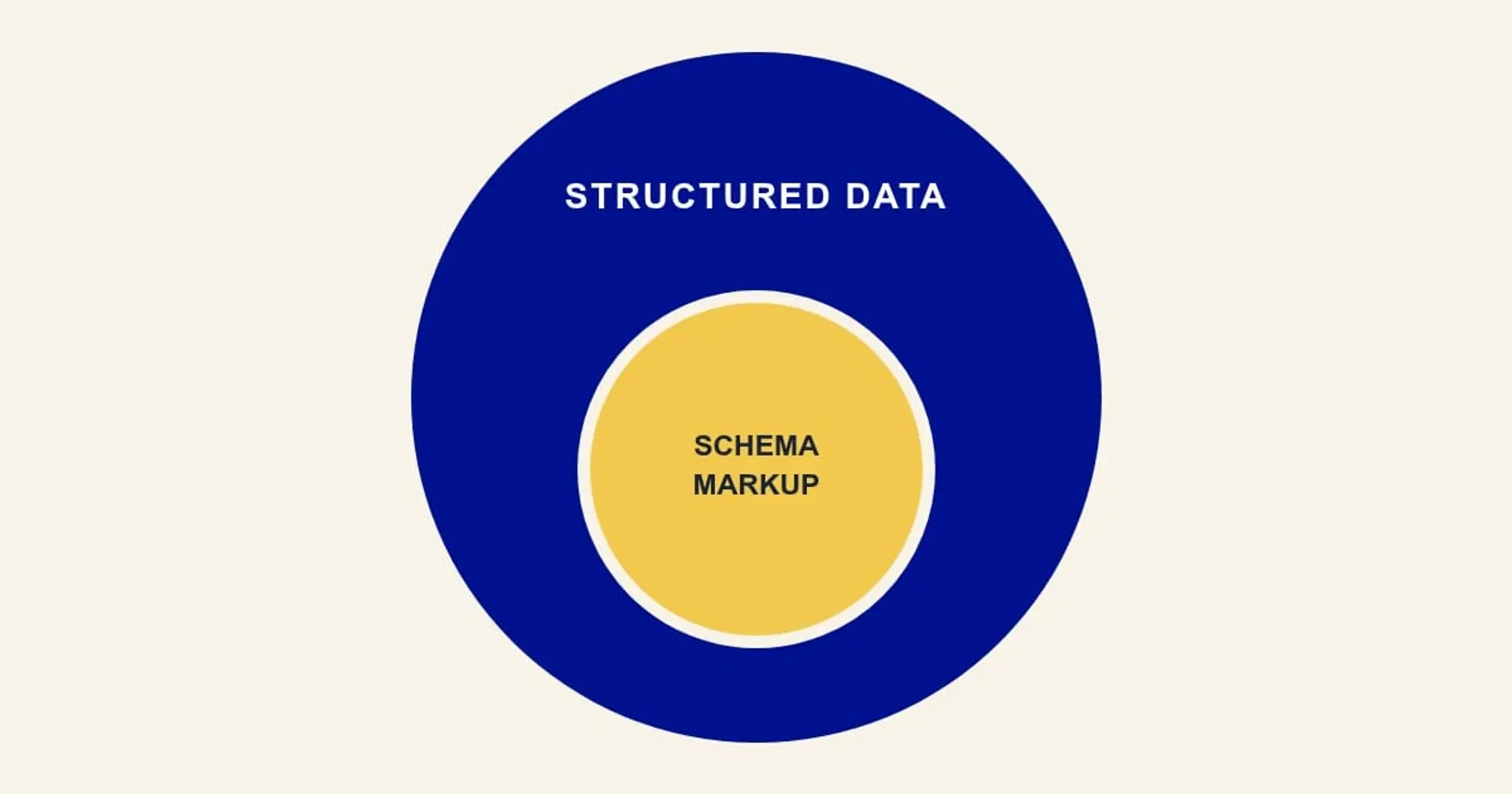
So whoever said it to my friend was technically right. Structured data is the umbrella. Schema markup is one thing underneath it. But unless you're being deliberately precise, or writing a cheat sheet (guilty), the two get used interchangeably for a decent reason: on the web, when someone says structured data, they mean schema markup about 95% of the time.
So don’t be bamboozled by the terminology (or the SEO gurus). It’s just plain ol’ jargon.
Why any of this existed before AI turned up
Schema markup wasn't built with AI in mind at all. It was built for rich search results, the nicer-looking search listings Google shows for products, recipes and events: star ratings, prices, a little info panel instead of a plain blue link.
The deal was simple:
Mark your page up correctly and Google might give you a rich result. Get it wrong, missing fields, mismatched data, and nothing bad happens. You don't get penalised, you just won't get the fancy, eye-catching formatting.
The goal here was to stick out on search pages with some visual distinction.
How does AEO relate to structured data?
This is where it’s use case expanded…
Structured data was always a way for a machine to understand a page, because it formats information as a data object rather than a paragraph of marketing waffle.
A price is just a price, not three sentences about unbeatable value. A rating is a number, not a paragraph about how “thrilled” the customer was.
That's exactly the format AI systems want when they're trying to answer a question accurately and at low cost. Because if you’ve used AI, you understand feeding it tonnes of content wipes through your usage quick. So leaner data is more efficient for it to read.
So the same markup built for prettier search listings has become useful for a different audience: little machine men running through the interwebs, describing your product, your organisation or your event correctly when someone asks it something.
Knowledge graphs: how to connect your structured data
Once you've marked up individual things, products, articles, your organisation, the next step is connecting them.
That's a knowledge graph: your product schema points to your organisation schema, which points to your local business listing, which points to your LinkedIn profile. Each one confirming the others and building out a lovely connected network of data.
Two bits of schema are used to create this connection:
- One says "this is the same entity as the one listed here" and links out to places like LinkedIn or Companies House.
- The other gives each entity on your own site a stable ID, so other schemas can point to it instead of repeating the whole thing.
Nest a few of these together and you've built a small, confirmed web of facts about your business, which beats a bunch of scattered isolated claims.
Structured data is bigger than schema markup though
This is probably the bit my friend's SEO person was circling, whether they were trying to sound mysterious, or just slipped up and assumed some knowledge. Or maybe they weren't thinking about this at all and just liked how the sentence sounded?
Types of website structured data (technically)
- Your HTML itself is structured data. Proper heading tags, paragraphs, lists, a <main> wrapping your core content: that structure tells a machine importance different content and how it relates.
- Your meta tags are structured data too, the meta title, the meta description, the robots directives telling a crawler what to do with the page.
- Your XML sitemap is a whole file dedicated to structuring "here is everything on this site and where it lives."
- Even llms.txt, the newer file some sites are adding to give AI agents a plain-language summary, counts as structured data, though adoption is still thin and it's early days as of today. Google does not currently use it when looking at your site, read their generative AI mythbusting guide here.
None of those are schema markup. All of them are, technically, structured data. Which is probably why the distinction sounds clever in conversation but is inherently confusing.
So was the SEO dude right?
Technically, yes *exhales and rolls eyes* I suppose he was.
Structured data and schema markup aren't the same thing, but schema mark up is structured data. Pedantic, if you ask me.
But now you know exactly how they're not the same thing, which is more than most people saying that sentence actually know (probably).
Oh yeah, the SEO/AEO structured data cheat sheet…
I've put the full breakdown:
- handy HTML tags worth using,
- useful schema types, when to use them and what they need,
- a full knowledge graph example,
- and more,
all on its own page as a cheat sheet you can bookmark and come back to when you're actually implementing these things (or asking someone else to).
View the cheat sheet hereDon’t worry, it doesn’t ask for your email or anything. It just a free-to-use handy resource :)
If you do want a website that handles all this wizardry by default, all my web design and development services include technical SEO and AEO by default. If you’d like to ask more about this, I’d be happy to chat.
- Article categories:
- Web design and development